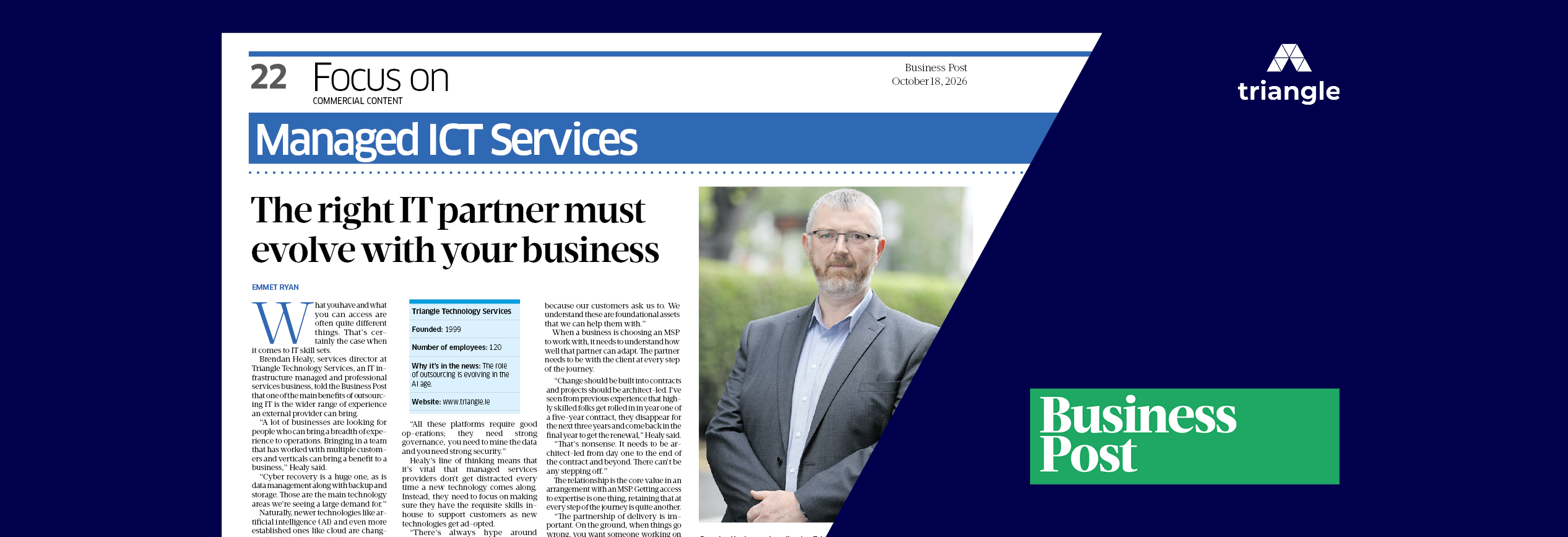
By year three of a five-year managed services contract, how much of the senior technical expertise that shaped the service is still involved? Triangle Services Director Brendan Healy raised this issue in a recent interview with the Business Post, describing a practice he has encountered:
"I've seen from previous experience that highly skilled folks get rolled in in year one of a five-year contract, they disappear for the next three years and come back in the final year to get the renewal."
His assessment was direct: "That's nonsense."
Access to expertise is one of the main reasons to engage a managed services provider (MSP). But the relationship has to deliver more than an experienced team at the outset. The people who understand the environment need to remain involved as it changes, throughout the contract and beyond.
Expertise needs to stay close to the environment
In the Business Post article, Brendan makes the case that one of the main benefits of working with a managed services provider is the breadth of experience an external team brings. Specialists who work across different organisations and industries encounter a wider range of infrastructure challenges, operational approaches and technologies. Cyber recovery, data management, backup and storage are the areas where Triangle is seeing significant demand for that capability.
That expertise becomes more valuable as the team builds a detailed understanding of the client's own environment. Enterprise infrastructure rarely stays as it was when a service began. New platforms are introduced, applications change, systems are upgraded and business requirements evolve. The people responsible for operating those systems need to understand what has changed, how the components depend on one another and why earlier decisions were made.
During a major incident, that accumulated knowledge is what counts. Familiarity of that kind cannot be substituted with expertise brought in only when a problem arises. As Brendan puts it in the interview:
"The partnership of delivery is important. On the ground, when things go wrong, you want someone working on the problem who is highly skilled and has been working in that environment."
Architect-led from design through operations
Brendan is particularly clear about the need for continuous architectural ownership: "It needs to be architect-led from day one to the end of the contract and beyond. There can't be any stepping off."
At Triangle, the architects involved in designing a service remain engaged after implementation. Project delivery and managed services teams work together, so the knowledge behind the original design carries through into decisions about performance, incidents and change. When new requirements emerge, those decisions are made by people who already understand the environment and its operational constraints.
In The role of an architect in building resilience, Brendan and Ciarán Garvey, Triangle's Lead Architect and Director of Technology, explain how this continuity works in practice: the relationship between service design and operations, and how architectural oversight keeps improvement aligned with business needs.
Change should be built into the contract
Architectural continuity is one part of the relationship. The contract also needs to support what the business is trying to achieve. For Brendan, it's the responsibility of a managed services provider to accommodate change:
"An MSP should never get in the way of change in a customer's business. We add new technologies to our teams regularly because our customers ask us to. We understand these are foundational assets that we can help them with."
A managed services agreement built around a fixed set of requirements introduces friction as those requirements evolve. Changes in capacity, new technologies or additional work can fall outside the original scope and need separate approvals and commercial arrangements before they can progress. For enterprise organisations, that slows down work that is already understood and necessary.
At Triangle, we've built these requirements into how our managed services operate. Fees can be adjusted as the estate changes, service requests have an agreed budget, and new technologies can be brought into the service through a defined process. Each change is still subject to architectural oversight and governance. The intention is to make necessary work easier to progress without compromising operational stability.
Brendan sets out this approach in his video on The everyday discipline of operational resilience, including the principle that contract economics should not get in the way of getting necessary work done.
New technologies still need sound operations
AI is bringing new requirements into enterprise IT, just as cloud did over a decade ago. But for Brendan, changing technology does not fundamentally change the responsibilities of the teams managing critical infrastructure. As he told the Business Post:
"There's always hype around new technologies. Even when cloud took off over a decade ago, we realised that it didn't impact how we operate. The key for us is that we have to be able to change with the customer."
New platforms still need to be operated, governed and secured. Their data needs to be managed and used effectively. For an MSP, the challenge is to develop the necessary skills as technology changes, while maintaining control of the infrastructure the business already depends on.
What happens in year three?
When selecting or renewing a managed services provider, enterprise organisations naturally examine technical capability, service levels and commercial terms. The delivery model warrants just as much attention.
Who will retain architectural responsibility after implementation? How will the contract accommodate new requirements? And if a major incident occurs in year three, will the people responding already know the environment?
The answers show how the relationship is likely to work once the initial project is complete and the service becomes part of everyday operations. A managed services partner should be able to demonstrate how it will retain expertise, govern change and keep improving the environment throughout the engagement. Those commitments need to hold in year three, not only at the start of the contract or when it comes up for renewal.
-----------------
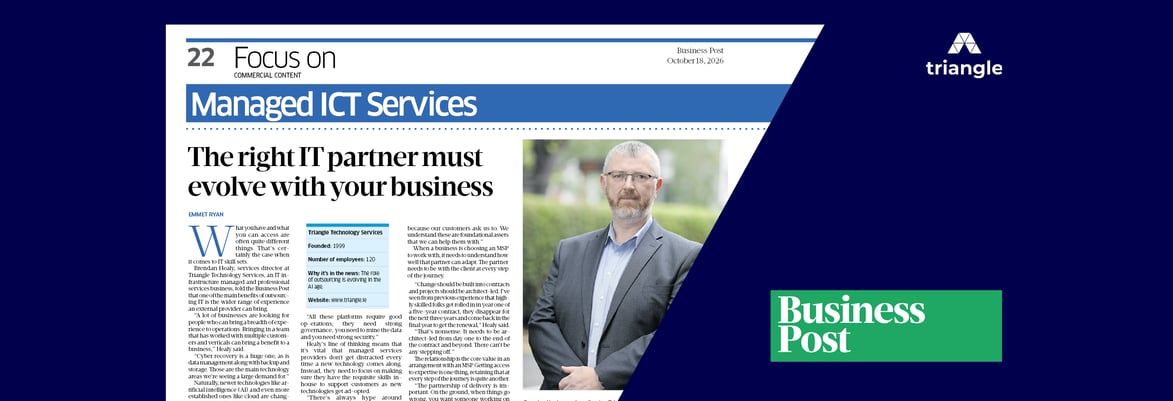
Read Brendan Healy's full interview in the Business Post >>
-----------------
Explore related: